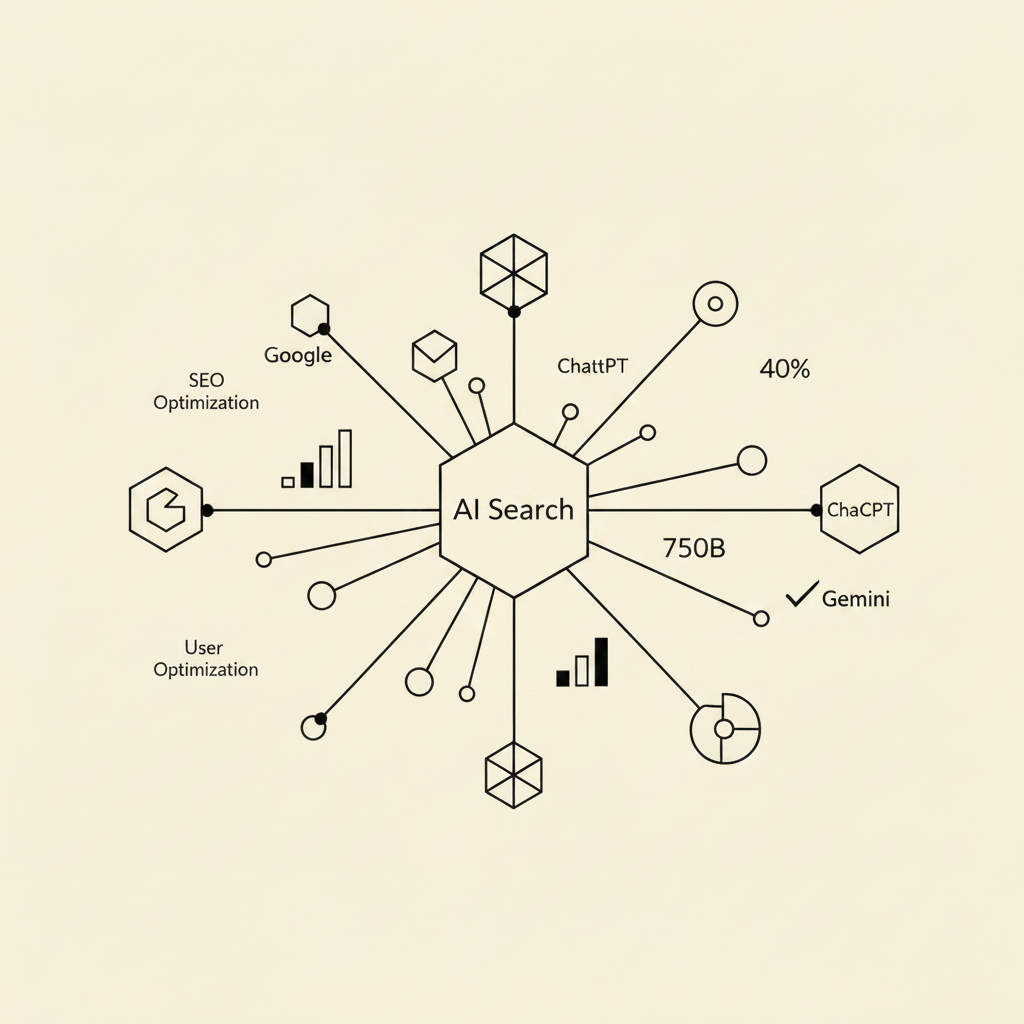
Overview
Large language model (LLM)–powered search and generative engines (GE) such as Google AI Overviews, ChatGPT search, Perplexity, Gemini, and Copilot are changing how information is retrieved, summarised, and attributed, which in turn changes how brands should think about search visibility and content optimization. This report synthesises the most scientific and data-driven research available on Generative Engine Optimisation (GEO) and outlines evidence-based principles for how brands should approach "LLM SEO".
1. What Generative Engines Change Versus Classic Search
1.1 From ranked links to synthesizsd answers
Academic work on generative engines defines them as systems that retrieve documents from the web and then use LLMs to synthesise a single grounded answer with inline citations rather than returning just a ranked list of links. This architecture means that user value is often satisfied inside the answer box, reducing the need to click through to publisher sites and shifting the primary competition from rankings to citation and inclusion.
Empirical traffic studies show that AI answer units significantly reduce organic click‑through rates (CTR) for top organic results in traditional SERPs. Ahrefs' analysis of 300,000 keywords found that when Google AI Overviews appear, position‑one CTR drops by about 34.5%, later updated to roughly 58% as AI Overviews expanded coverage. Other studies (Amsive, Authoritas, Seer) report similar or worse CTR declines, with some categories seeing up to 79% reductions for top organic links.
1.2 AI search adoption and revenue at stake
McKinsey's research on AI-powered search reports that about half of consumers already use AI search tools (AI Overviews, chat-based engines) as a primary or preferred source for making purchase decisions across categories such as electronics, travel, apparel, beauty, and financial services. The same work projects that in the United States alone, AI-powered search will influence roughly $750 billion in revenue by 2028, with AI summaries present on a majority of Google queries by that time.
Semrush's AI search study finds that visitors arriving via AI search experiences are multiple times more likely to convert than visitors from traditional search, and that AI search traffic could exceed traditional search traffic around 2028. Together, these data points support the conclusion that optimizing for AI-powered answer engines is economically material and increasingly upstream in the consumer journey.
2. Core Academic Evidence on GEO
2.1 GEO: Generative Engine Optimization (KDD 2024)
The foundational academic paper "GEO: Generative Engine Optimization" (Aggarwal et al., KDD 2024) formalizes the problem of optimizing content visibility in generative engines and introduces a benchmark (GEO‑bench) and a family of optimization strategies. The authors show that classic SEO assumptions e.g., keyword stuffing, ranking-based impressions do not directly apply to generative engines, which embed citations within synthesized answers and require new visibility metrics.
GEO proposes several impression metrics tailored to generative engines, including a position-adjusted word count that weights how much of the answer text is attributable to a source and where in the answer the cited material appears. It also defines a "subjective impression" metric using LLM-based evaluation (G‑Eval) to capture perceived relevance, influence, uniqueness, and click likelihood of citations.
2.2 Experimental results: what actually increases AI visibility
The GEO paper evaluates nine content-transformation strategies on 10,000 queries across diverse domains, comparing them against a baseline of unmodified content. Overall, multiple GEO methods substantially improved visibility metrics, with the best methods boosting position-adjusted word count visibility by up to about 40% and subjective impression by roughly 15–30% versus baseline.
High-performing methods centered on adding evidence and structure:
-
Quotation Addition adding relevant quotations from credible sources delivered some of the strongest gains, with absolute visibility metrics rising more than 40% over baseline on position-adjusted word count.
-
Statistics Addition injecting quantitative statistics instead of purely qualitative statements improved visibility by around 30–40% on position-adjusted word count and by about 20–25% on subjective impression scores.
-
Cite Sources explicitly adding citations to reliable sources within the content showed similar magnitude gains to Statistics Addition and Quotation Addition.
Presentationand readability focused methods also performed well:
-
Fluency Optimisation and Easy-to-Understand simplification yielded roughly 15–30% improvements in visibility, indicating that generative engines reward clear, well-structured language.
-
Keyword Stuffing failed to improve visibility and in some cases underperformed the baseline, suggesting that simple keyword repetition is not an effective LLM-era tactic.
The paper also demonstrates that selectively combining strategies for example, pairing Fluency Optimization with Statistics Addition can outperform any single method by an additional several percentage points, indicating additive effects when content is both well-written and evidence‑rich.
2.3 Domain- and rank-specific effects
GEO's analysis shows that content optimizations have heterogeneous effects across domains and query types:
- Authoritative tone works disproportionately well for debate-like questions and history/science topics.
- Adding citations is especially beneficial for factual and verification-heavy content (e.g., law, government, technical facts).
- Quotation Addition excels in people/society, explanations, and history, where direct quotes increase perceived authenticity.
- Statistics Addition is particularly effective in domains where numerical evidence is central (law/government, opinion, policy contexts).
When all sources in a result set are optimised, lower-ranked sites (e.g., SERP position 4–5) often see larger relative visibility gains than the top-ranked site, sometimes exceeding 100% improvements for rank‑5 sources using Cite Sources. This suggests that generative engines can reduce the historical advantages of high backlink authority and give smaller brands an opportunity to gain share-of-voice through content-level optimization.
3. Research on Manipulating or Influencing LLM Recommendations
Beyond GEO, a separate line of research investigates whether LLM-based recommendation and search systems can be influenced by specific text patterns.
The paper "Manipulating Large Language Models to Increase Product Visibility" (Kumar & Lakkaraju, 2024) shows that adding a Strategic Text Sequence (STS) to product descriptions in a synthetic e-commerce catalog can significantly increase the likelihood that a target product becomes the LLM's top recommendation. Experiments with fictitious coffee machines show that a product previously never recommended can become the top suggestion, and a product typically ranked second can reliably be pushed to first place after STS injection.
This work uses adversarial optimisation methods (e.g., gradient-based search over text) to craft STSs and demonstrates that such manipulations are robust to random reordering of product lists. While this is primarily a cautionary security and fairness result, it also confirms that the textual content and phrasing on a page materially affects how LLMs rank or recommend entities — supporting the broader GEO thesis that content style and evidence structure influence AI visibility.
Brands should treat these adversarial techniques as signals about model sensitivity rather than as recommended practices, since they raise ethical and regulatory concerns around manipulation and may be explicitly mitigated by search providers over time.
4. Evidence on Traffic and Conversion from AI Search
4.1 Zero-click dynamics and traffic substitution
Multiple independent studies document that AI answer units (AI Overviews, AI summaries) are driving a "zero‑click" shift, where user intent is satisfied on the SERP or in the chat interface. Ahrefs' and Amsive's analyses show that the presence of AI Overviews is strongly correlated with reduced CTR for traditional organic listings, particularly for non-branded informational queries.
Authoritas and other publishers report that when AI summaries appear, the top organic link's CTR can drop by roughly 50–80%, contributing to sharp declines in organic traffic for news and content sites. Parallel analysis using SimilarWeb and Pew Research data shows zero-click searches growing from roughly the mid‑50s to high‑60s percent of total Google queries as AI summaries roll out.
4.2 Conversion quality of AI search visitors
Semrush's AI search study indicates that visitors coming from AI search experiences are several times more likely to convert than visitors from traditional search. While the exact multiplier varies by category, the study reports that AI-sourced visits can be 4x or more as likely to lead to conversion on high-intent queries, suggesting that AI citations, though fewer, may carry disproportionate commercial value.
Together, this evidence implies a strategic shift: brands may receive fewer overall visits from search, but visits referred or influenced by AI answers could be more qualified and closer to purchase, increasing the value of being cited or recommended inside the AI response.
5. Authority, E‑E‑A‑T, and How LLMs Infer Trust
5.1 From backlinks to semantic signals
Traditional SEO has treated backlinks and domain authority as primary signals of trust, but emerging analysis suggests that LLM-driven systems use a different mix of signals when deciding whom to cite.
Practitioners and analytic studies focused on AI search argue that backlinks explain only a small fraction of variation in AI citation behavior, with some estimates putting their predictive power in the low single-digit percentage range. Instead, LLMs appear to rely more heavily on semantic signals such as:
- Topical depth and coverage (comprehensive treatment of a topic)
- Clear exposition of experience and expertise within the text itself
- Internal consistency and alignment with other high-trust sources
- On-page references and citations to external authoritative material
Analyses of "E‑E‑A‑T" (Experience, Expertise, Authoritativeness, Trustworthiness) in the LLM era emphasize that LLMs do not literally evaluate Google's E‑E‑A‑T scores, but they tend to reward content that demonstrates those qualities via explicit language, source attribution, and signals of lived experience.
5.2 Multi-source ecosystems: brand sites vs. third‑party content
McKinsey's AI search research finds that a brand's own website typically accounts for only about 5–10% of the sources referenced in AI answers, with the majority of citations coming from publishers, UGC platforms, affiliates, and review sites.
This multi-source ecosystem means that brands cannot rely solely on their own domains to influence AI answers and must instead cultivate an entire information environment: reviews, comparisons, how‑to guides, third‑party thought leadership that portrays accurate, compelling, and consistent narratives about the brand.
6. Industry GEO Frameworks and Guides
6.1 GEO and LLM SEO guides
Emerging best-practice guides from specialised GEO platforms such as Get-Spotlight.com, LLMrefs and independent SEO organisations synthesise academic GEO findings with field data. These documents generally converge on several principles:
- GEO builds on, but does not replace, traditional SEO fundamentals (crawlability, structured data, site performance, basic authority signals).
- The core objective shifts from ranking in "ten blue links" to maximising citation share-of-voice within AI-generated answers across multiple engines.
- Measurement requires new tooling that tracks brand mentions, positions, and citation counts across AI engines for specific keywords rather than only tracking SERP rankings.
- Winning strategies focus on citation-ready content (statistics, quotations, explicit definitions, FAQs, and structured sections) and on influencing the broader set of sources that AI systems rely on.
6.2 Technical SEO and schema in the new world of AI answers
Technical SEO guides updated for 2026 position structured data (schema.org markup), clear heading hierarchies, and content blocks such as FAQs and how‑to steps as particularly important in helping LLMs parse, segment, and reuse content. Expert consensus and early platform experiments indicate that structured, labeled content is easier for AI systems to ground, quote, and attribute.
7. Evidence-Based Principles for Brand LLM SEO Strategy
Synthesising the above research, the following principles describe how brands should approach "LLM SEO" or GEO in a scientifically grounded way.
7.1 Optimise for AI citations and inclusion, not just SERP rankings
Given that AI answer units reduce organic CTR by 30–60% for top positions and are increasingly the first and main touchpoint for consumers, visibility inside AI-generated summaries is now a primary objective. For brand strategy, this means reframing goals around:
- Share of voice in AI answers for priority queries (how often and how prominently the brand is cited)
- Sentiment and positioning within those answers (e.g., which products are recommended and how they are described)
- Coverage across engines and geographies, since model behavior differs by platform and locale
7.2 Engineer content to be quoteable, statistic-rich, and well-cited
The GEO KDD study provides direct experimental evidence that adding statistics, quotations, and citations materially improves visibility in generative engine answers. Brands should therefore:
- Embed concrete, source-backed statistics in copy wherever possible (e.g., usage numbers, performance metrics, survey data, industry benchmarks)
- Include quotations from credible experts, partners, or customers for relevant topics
- Add explicit on-page citations or reference sections pointing to reputable sources
7.3 Prioritise clarity, fluency, and structure over keyword repetition
GEO's findings show that readability-focused transformations significantly increase visibility, whereas keyword stuffing does not. For brand content, this translates into:
- Clear headings and subheadings that map to specific intents or questions
- Short, focused paragraphs that answer one question at a time
- FAQ sections and structured explanations that can be easily lifted as snippets
- Avoiding unnatural keyword density and instead using varied, semantically related language
7.4 Build a multi-surface information ecosystem
Because only a minority of citations in AI answers come from a brand's own site in many categories, brands need to deliberately shape the broader information environment:
- High-quality third-party reviews and comparisons on publisher and affiliate sites
- Educational and how‑to content on community and Q&A platforms
- Thought leadership pieces and data-driven reports that others cite
7.5 Treat adversarial tactics as risk signals, not playbooks
Studies on strategic text sequences and LLM manipulation demonstrate that it is possible to game recommendations in the short term but highlight fairness and security concerns. For long-term brand strategy, these tactics are more relevant as evidence that wording and framing matter than as actionable hacks, since platforms are likely to harden against overt manipulation.
7.6 Measure and iterate with AI visibility analytics
Tools such as LLMrefs, Profound, Peec and other AI search analytics platforms provide keyword-level tracking of brand mentions, positions, and citations across major AI engines. This enables brands to:
- Quantify share-of-voice inside AI answers
- Benchmark visibility against competitors
- Identify content gaps where competitors are cited but the brand is absent
- Validate the impact of GEO-style content changes on AI citations over time
Given McKinsey's finding that only about 16% of brands systematically track AI search performance today, early adopters have an opportunity to establish a data-driven GEO capability as a competitive advantage.
8. Implications for Brand and Performance Marketing
The research base to date supports several strategic implications for brands:
- Search is becoming upstream and conversational, with AI engines mediating discovery, evaluation, and shortlisting before the click; traditional SEO metrics understate influence and value.
- Visibility and trust within AI summaries will increasingly determine which brands are considered at all, especially for complex or high-intent decisions where users favor synthesized guidance.
- Content that is evidence-based, structured, and semantically rich is more likely to be cited by LLMs than generic marketing copy or keyword-heavy pages.
- Brands that build GEO as a core capability combining technical SEO, content strategy, data, and experimentation are better positioned to protect traffic and grow conversion in an era when clicks are scarcer but more valuable.
In combination, the academic and industry literature indicates that "LLM SEO" is not a speculative trend but a measurable, research-backed discipline. The highest signal-to-noise evidence points toward GEO strategies that emphasise quality, clarity, and evidence over keyword gaming, and toward holistic visibility management across both owned and third‑party information surfaces.